Trivia Master - Word Quiz Game
- 4.6
- Rating
- 10.00M
- Installs
- Free
- Price
 Analysis by App-foxy
I spent time with Trivia Master - Word Quiz Game as a quick general-knowledge challenge rather than as a game I would play for hours at once. That distinction matters. Its appeal is the ease of starting a round, answering a question, and moving on without a complicated setup. It is a free trivia game from Topy Games, rated for Everyone, and it runs on Android devices using version 7.0 or later. For a casual quiz app, that broad compatibility makes it easy to recommend to families, students, and anyone who likes testing what they remember in spare moments.
The game has built a sizeable audience, with over ten million installs and a 4.7 average from around one hundred seven thousand ratings. Those figures suggest that the basic format works for a lot of people, but they do not tell you whether it suits your particular habits. I found it most enjoyable when I treated it as a repeatable mental break: a few questions while waiting for an appointment, a short challenge with friends, or a way to revisit subjects I had not thought about in years.
How the everyday quiz experience works
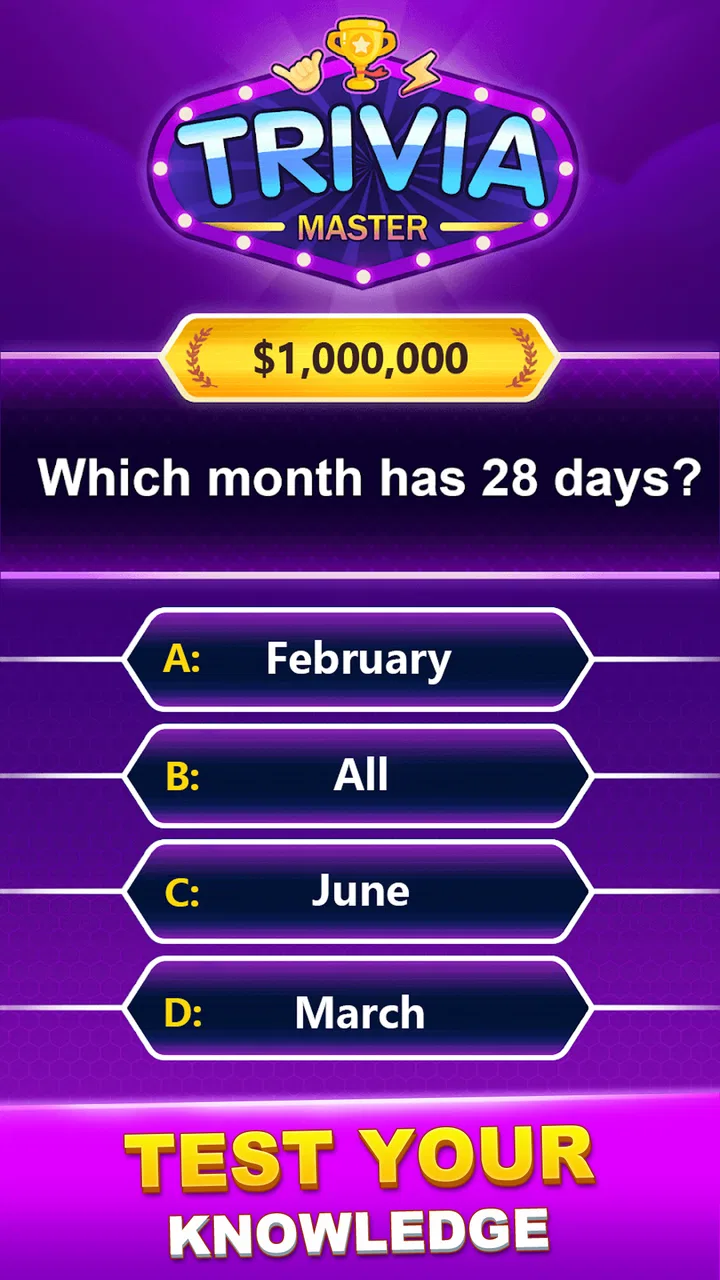
The central routine is straightforward. You open the game, begin answering trivia questions, and use your general knowledge to keep going. The catalogue is described as containing more than fifty thousand questions, so the experience is designed around variety rather than a small, fixed set that you memorize immediately. That is useful for casual play because a session can feel different from the previous one, even when you return to the same app several times in a week.
You May Also Like

 Blood Strike: 2.5 Anniversary
Blood Strike’s Loadouts Turn Every Drop Into a Tactical Gamble
A close look at Blood Strike’s custom loadouts: how fast access to signature weapons reshapes its battle royale rhythm, rewards preparation, and narrows the gap between fights.

 Pandora - Music & Podcasts
Pandora’s Music Is Easy to Start, but Harder to Recover
Pandora’s strength is its low-effort path from a seed to a station. Its weak spot is how much confidence it asks you to place in connection, setup, and quiet recovery.

 8 Ball Pool
 Is Built on Rivalries, Rematches, and Routine
A close look at the rivalries, rematches, shared routines, and unanswered safety questions that turn a quick pool match into a persistent mobile community.

 Samsung Music
’s Quiet Strength Is Playing What You Already Own
Its reach comes less from spectacle than from dependable access to a personal library. That simplicity is both the app’s strongest retention engine and its ceiling.

 AccuWeather: Weather Radar
AccuWeather Review: A Quick, Clear Forecast for Everyday Decisions
For everyday plans, the best forecast is the one you can understand quickly. AccuWeather makes rain timing, radar, and local conditions easy to act on, with a few trade-offs.

 Hill Climb Racing
Why Hill Climb Racing Still Turns Crashes Into One More Run
A tiny car, a bumpy hill and one more upgrade: Hill Climb Racing keeps resurfacing because its simple chaos makes every near-miss feel personal.
More From Our News Desk
View All News


I would not approach it like a carefully structured course. The questions are there to test recall and recognition, not to teach a subject in a planned sequence. When I missed an answer, the useful part was noticing the gap in my knowledge and remembering the explanation or correct choice for next time. That makes the game better for curiosity and self-testing than for anyone who needs formal lessons, detailed references, or a guaranteed progression from easy material to advanced material.
A practical baseline workflow is to play one short session without trying to optimize every answer. First, answer what you know immediately. Then slow down for questions where two choices seem plausible. This simple habit helps separate genuine knowledge from guesses, and it also shows whether you enjoy the pace. Some players will prefer quick instinctive answers, while others will get more satisfaction from carefully comparing possibilities.
The game works particularly well in situations where a full game is inconvenient. I can imagine using it during a commute as a passenger, before a meeting, or while taking a short break from work. It does not demand the same commitment as a long strategy game, and there is no need to remember a complicated story or control scheme. The trade-off is that its entertainment depends almost entirely on your interest in questions. If you want action, character development, or a strong sense of place, this will feel deliberately minimal.
It is also a reasonable choice for a shared screen. A family can pass the phone around and let each person answer, or friends can challenge one another on subjects where their knowledge differs. The Everyone rating makes that kind of use more comfortable, although adults should still remember that general trivia can vary widely in difficulty. A question that feels obvious to one player may be completely unfamiliar to another, which is part of the fun but can also make informal competition uneven.
What I would check before settling into regular play
Before building a daily habit, I would spend a few minutes looking through the available settings and on-screen options. I am not suggesting a hidden system that is not documented; rather, the useful practice is to check what the current version actually exposes on your device. Look for controls related to sound, notifications, language, question presentation, or other basic preferences, and adjust only what affects your comfort. A trivia game is much easier to keep using when it does not interrupt a quiet moment with unwanted audio or alerts.
This check is especially worthwhile if you play in public or at night. Muting sound, when the game offers that control, lets you use it discreetly. If you prefer reading questions aloud with friends, leaving audio enabled may make the shared experience more natural. These are small choices, but they change how well the game fits into everyday routines. I would also make sure the text is comfortable to read before beginning a long session, since trivia depends on catching the exact wording of a question.
Another useful setting habit is to review the purchase prompts rather than tapping through them automatically. The game is free to download, while in-app purchases are listed at $1.99 per item. That does not make spending necessary for the basic experience, but it does mean I would keep an eye on any optional purchase screen and decide in advance whether I want to pay for anything. For a casual quiz app, setting that boundary early avoids turning a five-minute break into an accidental purchase decision.
I would also check whether the current version behaves well on your particular phone before judging it too quickly. The listed version is 3.3, and software can feel different across screen sizes, Android versions, and device settings. If the question text seems cramped or the interface feels awkward, try changing the phone’s display settings or rotating the device only if the game supports it naturally. I prefer not to force a layout that was not designed for a particular orientation, because readability is more important than squeezing in extra questions.
Small habits that make repeated sessions better
Experienced quiz players usually gain more from a repeatable method than from simply playing faster. My preferred pattern is to divide answers into three mental groups: certain, likely, and unknown. I answer the certain ones quickly, compare wording carefully on the likely ones, and treat the unknowns as learning opportunities rather than as failures. This keeps a difficult question from spoiling the entire session and gives me a clearer idea of which subjects deserve more attention.
A second habit is to avoid changing an answer without a specific reason. Trivia questions often create doubt after the first instinct, especially when two options look familiar. I only revise my choice when I notice a concrete clue in the wording or recall a fact that contradicts my first response. Otherwise, changing answers becomes nervous guessing. This approach is not a feature of the app; it is a way to use a broad question bank more intelligently.
For a social session, I would have each player explain why they chose an answer before revealing the result. That turns a simple quiz into a conversation and exposes the difference between knowing a fact and recognizing a familiar word. It also makes the game less frustrating for players with different strengths. Someone who struggles with history may excel at science, language, geography, or pop culture, so rotating who chooses the next challenge can make the experience feel fairer.
Another practical workflow is to keep sessions short when your attention is divided. Trivia rewards careful reading, and answering while multitasking can make you miss a key word such as “not,” “first,” or “largest.” I get better results by playing when I can give the question a few seconds of real attention. If I am cooking, walking, or handling work messages, I would wait instead of blaming the game for mistakes caused by distraction.
The large question collection also changes how I think about replaying. I would not expect to remember every question, but I would expect repeated play to reveal familiar themes and recurring areas of weakness. After a few sessions, I might keep a simple note of subjects I repeatedly miss, then use that list to guide reading elsewhere. The game is not a replacement for a reference book, yet it can act as a useful prompt for deciding what I want to learn next.
Where the format has real limits
The same simplicity that makes the game accessible can make it feel shallow to certain players. A trivia question gives you a problem and asks for an answer, but it does not automatically provide the depth of a lesson, a source trail, or a long explanation. If your goal is to understand why an answer is correct, I would pair the game with a reliable book, class, or reference source rather than treating a correct response as complete learning.
There is also a natural limit to judging knowledge through multiple-choice or short-answer trivia. Recognition is easier than producing an answer from memory, and familiar wording can sometimes guide you even when you do not fully understand the subject. I found the game more valuable when I asked myself whether I could explain the answer afterward. That extra step turns a quick score into a more honest self-check.
Players who dislike uncertainty may find broad trivia uneven. One round can feel comfortable and the next can suddenly move into a subject you rarely encounter. I see that variation as part of the category, but it means the app is not ideal if you want complete control over difficulty or a narrowly focused topic. A dedicated subject-specific quiz would be better for someone preparing for a particular exam or building expertise in one field.
The free model is another point to consider. You can start without paying, which is important for trying the game before committing to it, but optional purchases at $1.99 per item may appear during use. I would recommend deciding whether you are happy with the free experience before buying anything. People who want a completely uninterrupted, purchase-free interface may prefer a paid alternative with a simpler commercial model, while casual users may find the free entry point more convenient.
I would also skip it if you need competitive features to stay motivated. Some people enjoy leaderboards, timed tournaments, detailed performance charts, or a visible progression system. Trivia Master is most convincing as an accessible question game, not as a full competitive training platform. If your enjoyment comes from comparing long-term statistics with a large community, another trivia product may offer a stronger reason to return.
How it compares with familiar trivia alternatives
Compared with a printed quiz book, this game is more convenient and easier to use in short bursts. You do not need to carry anything, turn pages, or prepare a score sheet. The disadvantage is that a book often gives you more room for explanations and lets you control the pace in a calmer way. I would choose the app for spontaneous practice and a book when I want a slower, more deliberate quiz night.
Compared with a search engine, the game is better at creating a challenge because it prevents you from choosing exactly what to look up. Searching is superior when accuracy and context matter, but it removes the test of memory. I like using the game first, then checking an interesting fact elsewhere if it sparks a question. That two-step routine keeps the quiz enjoyable without confusing it with a definitive educational source.
Compared with multiplayer quiz platforms, this title is a better fit for someone who wants a low-pressure solo session. Multiplayer alternatives can create excitement through live competition, but they may also require other players to be available at the same time. Here, I can open the game when I have a spare moment. The trade-off is less social urgency, so players who need rivalry may lose interest sooner.
Compared with subject-focused learning apps, it offers breadth instead of a planned curriculum. The wide range of questions is its strongest reason to exist, especially for people who enjoy moving from one topic to another without deciding what to study first. It is not the better option for mastering vocabulary, memorizing dates, or preparing for a professional test. In those cases, targeted practice with explanations and spaced repetition would be more effective.
Who will get the most from it
I would recommend it to people who enjoy general knowledge, want a free way to fill short pauses, or like discovering which subjects they know better than expected. It is also suitable for families looking for a simple shared activity that does not require complicated rules. The Everyone rating supports that broad audience, although the changing difficulty means younger players may need help reading or discussing unfamiliar questions.
It is a good match for a student who wants a light warm-up before studying, provided the student does not mistake trivia success for full subject knowledge. It can also suit an adult who wants a screen break that feels more active than scrolling. My most useful scenario is a short, focused session followed by a note about one or two questions I want to investigate. That gives the game a purpose beyond collecting correct answers.
I would be more cautious about recommending it to someone who becomes frustrated by random subject changes, dislikes optional purchase prompts, or expects every answer to come with a detailed explanation. It is also not my first choice for formal revision, serious competition, or players who need a strong narrative. Knowing that before downloading it is helpful: the game is enjoyable when you want variety and immediacy, not when you want a complete learning system.
My verdict after building a routine around it
After using it with a few simple habits, I see Trivia Master - Word Quiz Game as a dependable casual trivia option rather than an all-purpose knowledge trainer. Its free starting point, broad question collection, accessible age rating, and low technical entry requirement make it easy to try. Topy Games has kept the main idea clear: open the game, face a question, and see what you remember.
The strongest way to use it is to control the surrounding routine. Check the available settings, keep sound and interruptions suited to the situation, answer carefully instead of racing, and treat missed questions as prompts for further learning. Those steps do more for the experience than chasing a perfect session. They also reveal the app’s boundaries early, especially if you need detailed explanations, fixed subjects, or a serious competitive structure.
With a 4.7 average and more than ten million installs, it has clearly found a large audience, but popularity alone would not be enough for my recommendation. I recommend it because the format fits real spare moments and because the broad trivia approach gives each session a reason to feel slightly different. The final decision comes down to what you want from a quiz: choose this game for quick, varied knowledge checks, and choose a more specialized alternative when depth, control, or competition matters more.
FAQs for Trivia Master - Word Quiz Game
01What is the main objective of Trivia Master - Word Quiz Game?
Trivia Master - Word Quiz Game is designed to challenge your knowledge across a wide range of topics. The main objective is to correctly answer trivia questions to earn points and progress through levels. As you advance, the questions become more challenging, testing your expertise and quick thinking skills.
02Is Trivia Master - Word Quiz Game free to play?
Yes, Trivia Master - Word Quiz Game is free to download and play. However, it does offer in-app purchases for items such as extra lives, hints, and ad removal. These purchases are optional and not necessary to enjoy the full experience of the game.
03What types of questions can I expect in the game?
The game includes a diverse array of questions covering topics like history, science, pop culture, sports, and more. Questions are designed to be both educational and entertaining, ensuring players not only test their knowledge but also learn new facts along the way.
04Can I play Trivia Master - Word Quiz Game offline?
Trivia Master - Word Quiz Game requires an internet connection to download new questions and updates. While some features may be available offline, such as reviewing past questions, playing and progressing through new levels typically requires being online.
05Does the game offer any multiplayer or social features?
Yes, Trivia Master - Word Quiz Game includes social features that allow you to challenge friends or compete with players worldwide. You can connect your game to social media accounts to share achievements and invite friends to join the trivia fun, adding a competitive edge to your experience.
Pros
- Engaging and challenging questions.
- Smooth and intuitive user interface.
- Regular updates with new content.
- Multiplayer mode enhances competition.
- Offline play available for practice.
Cons
- Ads can be intrusive at times.
- Some questions may repeat.
- Limited customization options.
- Requires internet for updates.
- In-app purchases can be pricey.

Trivia Master - Word Quiz Game
Gallery